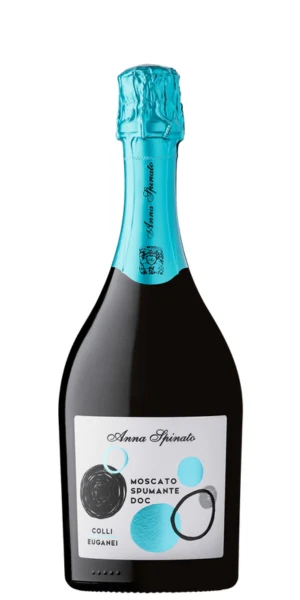
Anna Spinato, Moscato Spumante, Colli Euganei
Delicious Sweet Sparkling Wine from Veneto
Pale yellow with subtle green reflections, this sparkling Moscato shows a soft, compact foam and a fine, persistent perlage. The nose is rich and seductive, bursting with vibrant fruity and aromatic notes. On the palate, it offers a full and sumptuous sip, beautifully echoing the aromas with a harmonious and expressive finish.
- 100% Moscato giallo (yellow Muscat)
- Residual Sugar: 90g/lt (Sweet)
- 91Pts Gilbert & Gaillard
Food Paring: Ideal with fruit tarts, cake and dry biscuits. Worth a try with millefeuille cake with custard | Best served at 6°/8° C
STORY BEHIND THE WINE
The must is decanted briefly at a temperature of 10°C before chilling to 0°C in order to prevent fermentation and stored at 0°C until it undergoes conversion to a sparkling wine. The secondary fermentation takes place into a steel tank under controlled temperatures until the desired grade of alcohol is reached. The fermentation is then blocked by a rapid reduction in temperature.
Product Information
Product Information
Shipping & Returns
Shipping & Returns
Description
Delicious Sweet Sparkling Wine from Veneto
Pale yellow with subtle green reflections, this sparkling Moscato shows a soft, compact foam and a fine, persistent perlage. The nose is rich and seductive, bursting with vibrant fruity and aromatic notes. On the palate, it offers a full and sumptuous sip, beautifully echoing the aromas with a harmonious and expressive finish.
- 100% Moscato giallo (yellow Muscat)
- Residual Sugar: 90g/lt (Sweet)
- 91Pts Gilbert & Gaillard
Food Paring: Ideal with fruit tarts, cake and dry biscuits. Worth a try with millefeuille cake with custard | Best served at 6°/8° C
STORY BEHIND THE WINE
The must is decanted briefly at a temperature of 10°C before chilling to 0°C in order to prevent fermentation and stored at 0°C until it undergoes conversion to a sparkling wine. The secondary fermentation takes place into a steel tank under controlled temperatures until the desired grade of alcohol is reached. The fermentation is then blocked by a rapid reduction in temperature.